
What Is the Merging Traffic Sign? Ohio Rules for Merging Lanes
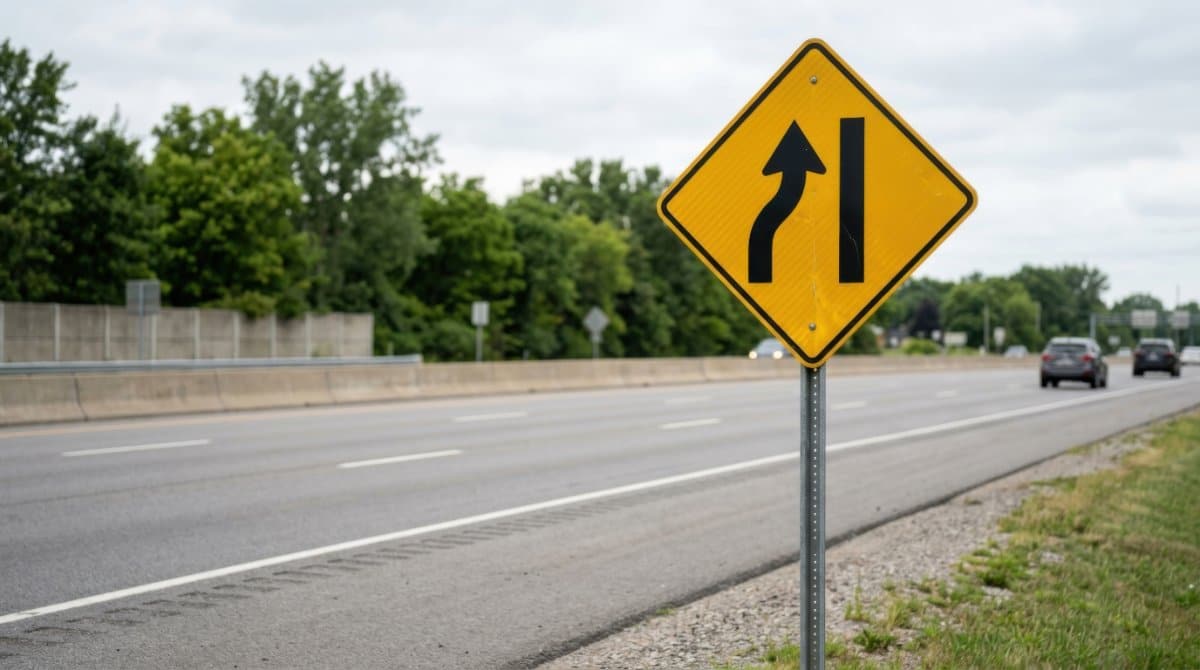 The merging traffic sign tells drivers that two different roads are about to converge and become one. There are rules for how drivers should react when they see this sign. When motorists do not respond correctly, accidents can happen.
Crandall & Pera Law, LLC helps clients who have suffered injuries in merging accidents. Reach out to our experienced car accident lawyers today if you were injured due to a negligent driver.
Merging traffic signs – what they look like and where to find them
Merging traffic signs are diamond-shaped, yellow, and have black markings. They show a straight black arrow pointing upward with a line representing another roadway curving into the side. The side the curve is on shows drivers where merging traffic will enter from.
You will find merge signs posted ahead of the section of road where you need to merge.
Who has the right of way when merging?
Merging lane rules in Ohio require vehicles merging onto a road to yield to those already traveling in the roadway. This means that the merging driver has the responsibility to watch for cars coming down the road and enter when there is a safe space to do so, and the driver already in the roadway has the right of way.
In order to merge safely, the merging driver should use their turn signal and mirrors. They should also use the acceleration lane to match their speed to the cars on the road they are entering. When there is heavy traffic or construction and multiple lanes must merge, zipper merging is the best method. This involves drivers taking turns from both lanes. Traffic locks together, like the teeth of a zipper.
Who is to blame for merging accidents?
As discussed, the driver merging must yield, and the driver already on the road has the right of way. Therefore, the merging driver is often liable for not yielding, which can result in cutting off another driver. However, the driver already on the road cannot do things like speed up, suddenly change lanes, or intentionally block a driver from merging. These actions could make them liable, at least partially.
A jury determines liability by assessing whether a party acted negligently. Negligence is based on the following:
- Duty of care – When driving, this is the responsibility everyone has to obey traffic laws and prevent causing accidents.
- Breach of duty – A breach happens when someone does not behave reasonably, based on what most other people would do in the same situation. In a merging accident, failure to yield or blocking someone from merging would both be examples of breaches.
- Causation – The breach of duty caused a victim’s injuries.
- Damages – The victim suffered losses because of their injury.
In some instances, juries decide that both drivers bear some of the fault. If this happens in your case, you can still receive compensation, as long as your fault is not above 50 percent.
Here is how it works. Say a driver sideswiped you because they merged without yielding, but you were going 15 mph over the speed limit. The jury decides that because you were going too fast, 20 percent of the fault for the crash is yours. If you have $100,000 in damages, you would get $80,000. But if the jury had decided you were even 51 percent at fault, you would get nothing.
This assignment of fault is known as comparative negligence. Many car accident cases settle through auto liability claims and negotiations, but this rule will still matter even if you do not go to trial because insurance companies understand the law and will apply it to your settlement offer. It is important to build the strongest possible case so that you can obtain full compensation and preserve your right to recover damages.
How can you prove car accident liability?
You and the other driver involved in your merging accident (and their insurance provider) may have two different versions of the events that led to your collision. Additionally, the insurance company will likely look for any reason to place blame on you so that it can pay you less or not pay you at all. To prove merging accident fault in Ohio, you must support your claim with solid evidence.
Dashcam video from either vehicle could show what happened, as could traffic camera or surveillance footage that may have caught the crash. An attorney could help you track video evidence down, including sending a formal legal request for anything in the other driver’s possession.
Police reports and eyewitness accounts can also back you up. Your lawyer can get copies of documents from law enforcement and locate and interview people who saw your wreck.
If necessary, an attorney could also hire a crash reconstruction expert to piece together what happened and testify on your behalf.
When should you seek compensation?
You should seek compensation for a merging accident if another driver was at fault and you have medical bills, lost wages, and other damages, including pain and suffering. You should file a claim against the liable driver’s auto insurance policy right away.
Unless the insurance company pays your claim immediately and fully (usually not likely), you should also consult with a lawyer. An attorney can handle case building for you and aggressively represent you in your pursuit of compensation.
If you must sue for damages, you have a limited time to file your case in civil court. Ohio Rev. Code § 2305.10 sets a two-year statute of limitations for most personal injury lawsuits. Do not wait too long to learn about your legal options or take action.
Consult with Crandall & Pera Law, LLC about your injury claim
When cars have to merge, accidents are not uncommon. Drivers can get confused about the rules for merging or merge incorrectly, leading to crashes and injuries. If you were hurt and another driver was at fault, they should pay for your damages, but you will need to prove they are liable.
A car accident lawyer with Crandall & Pera Law, LLC can help you do this. We have over 50 years of combined personal injury experience to help you seek compensation. Contact us today for a free consultation. We have eight offices across Ohio and Kentucky and advocate for clients statewide.